

Gimbals, pan-tilt units, small unmanned vehicles: everyadded gram costs flight time, slew speed, or payload. The AHRS-M1 is sized forexactly that constraint, and it doesn't ask for the weight back in performance.
AdaptCal learns a platform's magnetic signature from its own motion. No traditional 12-point calibration. AdaptNav's real-time noise characterization keeps heading, pitch, and roll steady even on electrically and mechanically noisy platforms.
1.5° RMS static heading accuracy. Full 360° rollover using quaternions or rotation matrix. A ±16 Gauss magnetic range means it keeps working near motors and actuators that would throw off a narrower-range sensor.
NorthTek, Sparton's onboard Forth environment, makes theAHRS-M1 the only micro-sized AHRS that's user-programmable at the sensor level.






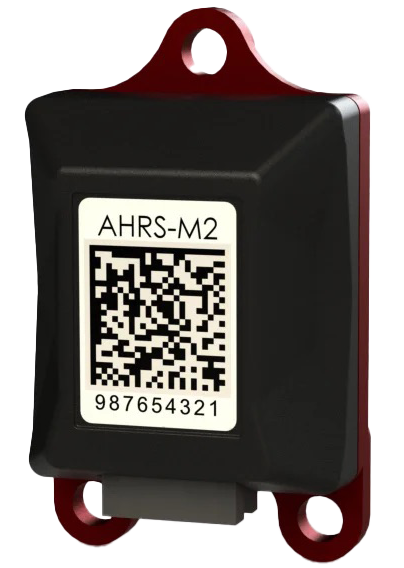
0.2° RMS static heading accuracy, holding under 1.0° RMS across the full -40° to +70°C range, not just at room temperature. That's roughly 7.5 times tighter than a standard-grade micro AHRS.
AHRS-M2 runs the same AdaptCal and AdaptNav foundation as the rest of the line, paired with a high-resolution, low-noise magnetometer tuned for precision near Earth-field strength. The accuracy number holds on noisy, moving platforms, not just in a lab.
60 mW operating, with a 16 mW sleep mode for platforms that need to conserve battery between readings. Update rate is selectable between 10 and 100 Hz, so integrators can trade bandwidth for power.
The 10-pin interface carries two reserved GPIO and a reserved UART. Integrators get headroom for future functionality without a hardware redesign.

140-0087-002
Connect M1 compasses to a computer via USB. Communicate with and provide power to unit. Change EEPROM settings. CAN NOT be used to flash units with a new firmware.
140-0088-002
Connect M2 compasses to a computer via USB. Communicate with and provide power to unit. Change EEPROM settings. CAN NOT be used to flash units with a new firmware.
